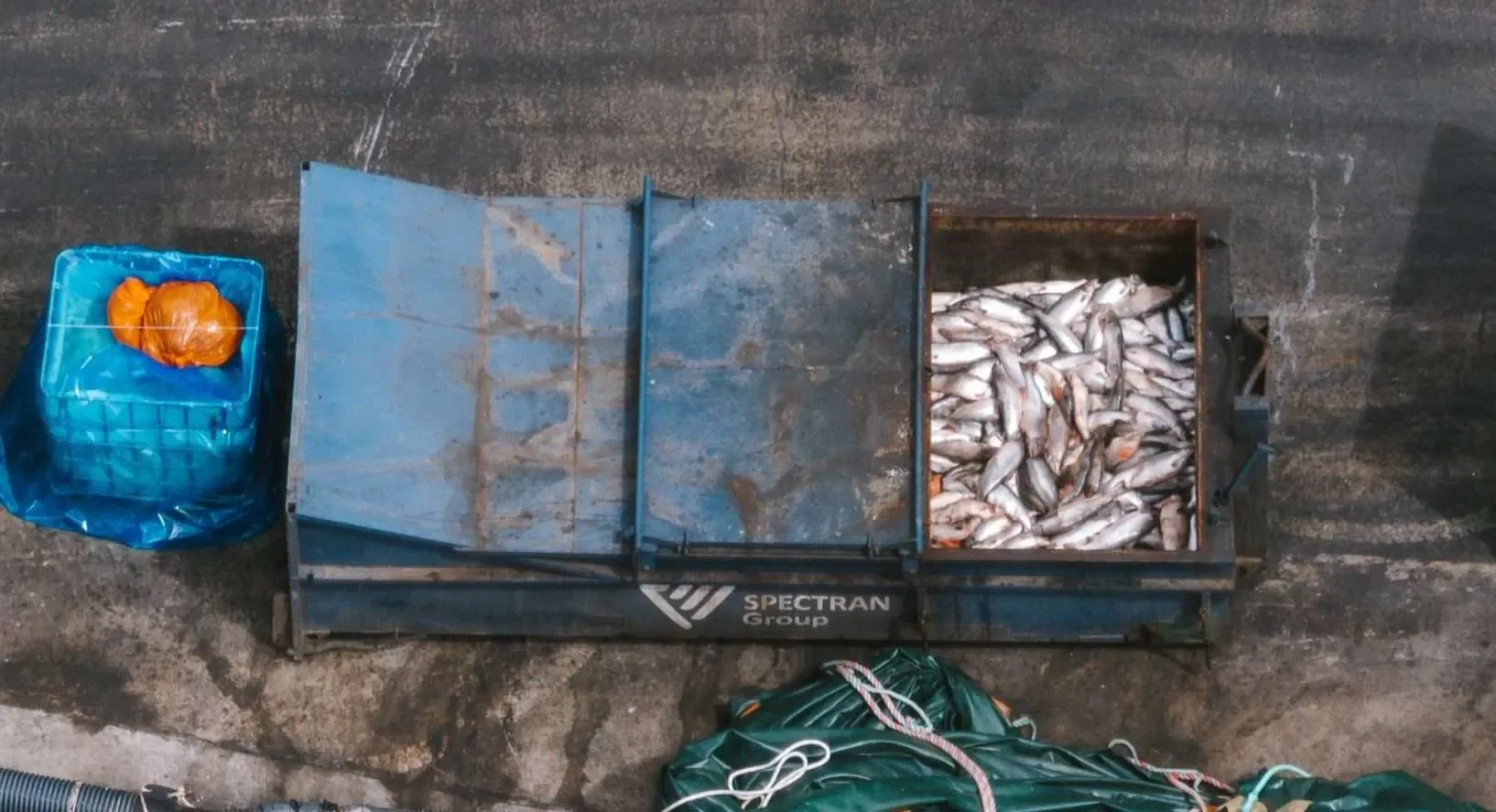
Dead salmon being removed from Tasmanian factory fish farms, February 2025. Image: Bob Brown Foundation.
This is Part 2. If you missed Part 1 - the nutritional case for reconsidering farmed Atlantic salmon - read it here.
What's happening in Tasmanian waters
My father fished the waters around Tasmania for decades. He knew those channels and bays the way you know a road you've driven a thousand times - the currents, the reefs, the weather patterns, the behaviour of the sea in different seasons. The fishing he did was regulated, skilled, and conducted with the kind of care that comes from understanding you are dependent on the health of what you're harvesting.
Industrial salmon aquaculture operates on a different logic entirely.
In early 2025, something happened in the D'Entrecasteaux Channel that made national news, though not as loudly as it should have - in my opinion. A bacterial outbreak of Piscirickettsia salmonis tore through salmon farms operating in the channel. EPA Tasmania data confirmed that over 10 million kilograms of Atlantic salmon died across February and March 2025 alone - approximately 2.5 million individual fish, representing an estimated 13% of Tasmania's entire annual salmon production.⁵
Congealed oily material - literal fatty globs confirmed to originate from fish - washed onto beaches along the channel: Verona Sands, Randalls Bay, Roaring Bay, Drip Beach in the lower Port Cygnet area, and beaches on the western side of South Bruny Island.⁶ The EPA directed two salmon companies operating 14 fish farms in the channel to stop discharging fish carcasses and waste into the environment.
This is not a hypothetical. It is EPA-documented, in the channel I know and love, in the water where many Tasmanians fish, swim, and gather shellfish.
I want to be honest about the limits of what I can say: there is no published research to my knowledge that has specifically quantified the human health risk of consuming shellfish and abalone from areas immediately adjacent to these farm sites. What I know is that I've changed my own behaviour. I'm no longer eating shellfish from areas of the channel that sit close to farming operations - which, as I said, happens to be adjacent to our family shack. I think that's a reasonable precautionary position while better data is gathered.
Excessive nutrient loading from aquaculture operations - waste, feed residues, excess nitrogen - has been documented to contribute to algal blooms and dead zones in receiving waters.⁷ Filter feeders like oysters and mussels concentrate what's in their environment. In clean water that makes them exceptional food. Near a pollution source, it's worth taking a significant pause.
The story doesn't end there. In November 2025, the same bacterial outbreak triggered an emergency permit from the Australian Pesticides and Veterinary Medicines Authority (APVMA) allowing salmon producers to use florfenicol, a broad-spectrum antibiotic, in open-water marine pens in the channel. Approximately 700 kilograms of florfenicol entered the D'Entrecasteaux Channel over the following months.¹²
Testing by the Institute of Marine and Antarctic Studies found florfenicol present 10.6 kilometres from the nearest treated salmon pen. Of 840 samples taken from wild species - rock lobster, abalone, sea urchins, mussels, and periwinkles - 165 tested positive.¹³ Rock lobster and abalone are exported under zero-residue protocols. Any detectable florfenicol means they cannot go to market. Areas of the rock lobster fishery - the same fishery my father worked for decades - had to be closed as a direct result.¹⁴
In March 2026, the APVMA suspended the emergency permit, citing "unacceptable risk" to non-target species. But the damage to wild fisheries, and to the wild fishing families who depend on them, was already done.
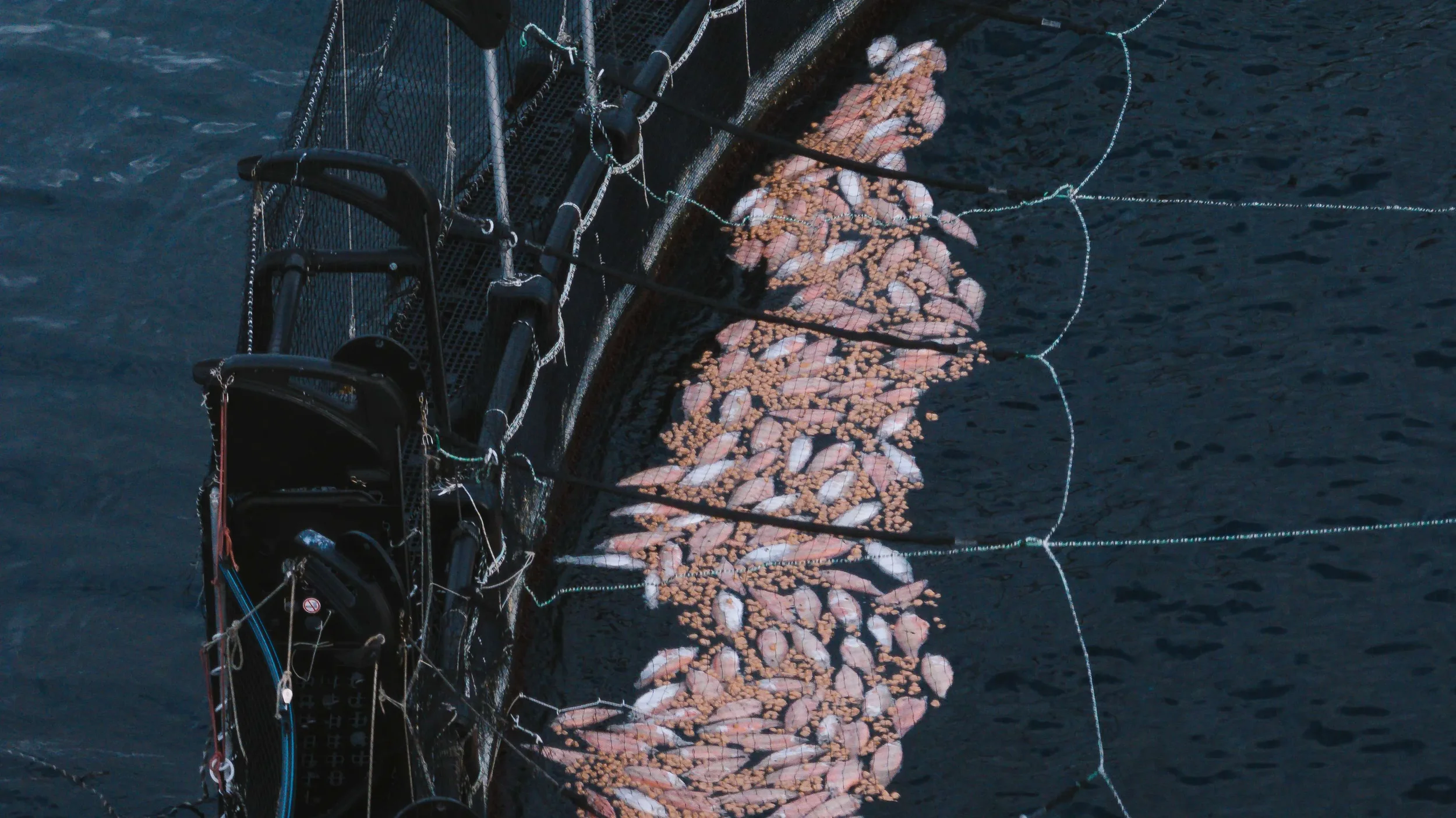
Salmon pens in the D'Entrecasteaux Channel, southern Tasmania. Image: Bob Brown Foundation.
A global pattern, not a local problem
Tasmania is not an outlier. The four countries producing 96% of the world's farmed Atlantic salmon - Norway, Scotland, Canada, and Chile - have accumulated an estimated USD $50 billion in economic, environmental, and social costs since 2013.¹⁵ Sea lice infestations, disease outbreaks, and escaped fish interbreeding with and genetically weakening wild salmon populations are documented across all of them. Chile saw catastrophic infectious salmon anaemia outbreaks and mass algal bloom mortality events. Scotland's industry has faced sustained criticism for the ecological state of its sea lochs.
These are not isolated incidents. They are systemic features of intensive open-water aquaculture in marine environments. As climate change puts increasing pressure on ocean temperatures, pH, ecological systems, and disease dynamics, the conditions that drive these outbreaks are only going to worsen.
What the new research actually tells us
In June 2026, a narrative review published in the International Journal of Food Sciences and Nutrition examined how different fish species contribute to both nutritional adequacy and environmental sustainability - and the findings are compelling.⁸
Fish can support sustainable diets, but species and production methods matter enormously. In dietary modelling studies across multiple European countries, fish frequently appeared in optimally designed diets - not because more fish is always better, but because fish was replacing red and processed meat, which carries a significantly heavier environmental footprint. Beef cattle create greenhouse gas emissions roughly eight times greater than those of farmed fish. The benefit comes from substitution, not addition.
Small pelagic fish and mollusks carry the lightest environmental burden. Sardines, anchovies, mackerel, oysters, mussels - these are the species that perform best across multiple environmental measures: greenhouse gas emissions, land use, freshwater use. In contrast, crustaceans and some intensive aquaculture systems can be more carbon-intensive than they appear.
The review carries an important disclosure: it was supported by Bolton Food S.P.A., a canned fish company. The authors stated the funder had no role in study design or interpretation, and the findings are consistent with the broader literature. I note it because that's how science should be read - with full visibility of who paid for it.
The broader message is one I find genuinely hopeful: the foods that tend to be better for us are often better for the planet too. Whole, lower-trophic-level seafood. Less red and processed meat. More plant diversity. That pattern reflects something fundamental about how ecosystems work and what humans are actually adapted to eat.
The planetary health conversation we're not quite having in Australia
Internationally, the conversation about food and sustainability has moved well beyond theory. The EAT-Lancet Commission, now in its second iteration, has updated its Planetary Health Diet recommendations to reflect new evidence - including an upward revision of lives potentially saved from 11.6 million to 15 million annually through dietary shift, alongside reductions in greenhouse gas emissions from agriculture of more than 50%.⁹
Sixteen cities globally - including New York, Seoul, and Milan - have committed to using the Planetary Health Diet to guide food policy. Countries like Denmark and Italy have adapted the framework to their own food cultures.
In Australia, this conversation has been slower to land in mainstream dietary guidance. Our national dietary guidelines don't yet formally incorporate a sustainability lens the way some international frameworks do. I think that's changing, and practitioners have a role to play in that shift - not by becoming environmental advocates in the consulting room, but by helping people understand that "is this food good for me?" and "is this food good for the ecosystem I live in?" are not as separate as we've been trained to treat them.
So what should we actually eat?
Telling people to avoid farmed salmon without pointing them somewhere useful isn't good enough, so here's where I'd start.
The GoodFish Guide (goodfish.org.au), produced by the Australian Marine Conservation Society, is a free traffic-light resource - green, amber, and red based on current scientific data on fisheries management and environmental impact. It's what I use, and it's what I recommend to patients.
Some current green-list highlights:
Oysters and mussels - farmed bivalves are among the most sustainable foods on earth, full stop. They require no feed, filter the water, and have among the lowest environmental footprints of any protein source. In clean water, they remain excellent food.
Australian-farmed barramundi - widely available, responsibly managed, a solid alternative.
Murray cod (farmed in land-based ponds) - minimal environmental impact.
Southern calamari from Victorian, Western Australian, and South Australian fisheries - fast-growing, strong populations.
Sardines and anchovies - wild-caught small pelagics are ecologically low-impact, rich in omega-3s, and chronically underused in the Australian diet. In my view, these are the fish most worth eating more of.
Wild-caught rock lobster (crayfish) - sustainably managed in Australian waters, with a long history of responsible fishery oversight. This one is personal to me. My father spent his working life pulling cray from these waters, and what he did is exactly the model of wild harvesting that deserves support.
Wild-caught salmon from sustainable Alaskan fisheries (look for MSC certification) remains a different proposition from farmed Atlantic salmon. If salmon is important to you, this is the version worth seeking out - though it's harder to find in Australia and carries a higher price point.
A note on nuance
Creating fear around food is not what I'm here to do, and it's not consistent with how I practise.
Fish, including some farmed fish, remains nutritionally valuable for many people. The context of your whole diet matters far more than any single food. For people who don't eat meat, farmed salmon may still represent a meaningful source of long-chain omega-3 fatty acids, even if the absolute amounts have declined.
The bottom line? Sustainable seafood and nutritious seafood turn out to be largely the same seafood. Come back to that every time you're standing in front of the fish counter or reading a menu - and use the GoodFish Guide as your companion when you do.
Chantel Yates is a naturopath and herbalist practising on muwinina land in Tasmania. She is also a fisherman's daughter who grew up on the water and has a deep respect for Tasmania's oceans, wild fisheries, and the people who work them responsibly. This post reflects her clinical perspective informed by current evidence and is intended as educational information, not personalised medical advice. For individual dietary guidance, please work with a qualified practitioner.
References
Søfteland, L. et al. (2025). Nutrients and contaminants in farmed Atlantic salmon (Salmo salar) fillet and fish feed from 2006 to 2021. Food Chemistry: X. https://www.sciencedirect.com/science/article/pii/S2666154325003047
Turchini, G.M. et al. (2019). The omega-3 long-chain polyunsaturated fatty acid "squeeze": Past, present, and future. Annual Review of Food Science and Technology, 10, 301–322.
Lundebye, A.K. et al. (2020). An update on the content of fatty acids, dioxins, PCBs and heavy metals in farmed, escaped and wild Atlantic salmon (Salmo salar L.) in Norway. Nutrients, 13(1), 1. https://pmc.ncbi.nlm.nih.gov/articles/PMC7766777/
Monikh, F.A. et al. (2024). Microplastics in feed affect the toxicokinetics of persistent halogenated pollutants in Atlantic salmon. Environmental Pollution. https://www.sciencedirect.com/science/article/pii/S0269749124011357
Tasmanian Times. (May 2025). Ten million kilograms of diseased and dead salmon. https://tasmaniantimes.com/2025/05/ten-million-kilograms-of-diseased-and-dead-salmon/
EPA Tasmania. (March 2025). EPA Update on Salmon Mortality Event. https://tasmaniantimes.com/2025/03/epa-update-on-salmon-mortality-event/
Tasmanian Inquirer. Mass protest against pollution of southern Tasmanian waterway with rotting salmon waste. https://tasmanianinquirer.com.au/news/mass-protest-against-pollution-of-southern-tasmanian-waterway-with-rotting-salmon-waste/
Dolci, A. et al. (2026). Environmental burden of fish in healthy and sustainable diets. International Journal of Food Sciences and Nutrition, 1–25. https://www.tandfonline.com/doi/full/10.1080/09637486.2026.2658821 - Disclosure: study supported by Bolton Food S.P.A.; authors state funder had no role in study design or interpretation.
EAT-Lancet Commission 2.0. (2025). Healthy, sustainable, and just food systems. https://eatforum.org/eat-lancet/
GoodFish Australia - Australia's Sustainable Seafood Guide. Australian Marine Conservation Society. https://goodfish.org.au/
Ragusa, A. et al. (2024). Frontiers in Cellular and Infection Microbiology. https://pmc.ncbi.nlm.nih.gov/articles/PMC11635378/
Chemwatch. (2026). Florfenicol and the Tasmanian Salmon Crisis. https://chemwatch.net/blog/florfenicol-and-the-tasmanian-salmon-crisis-what-it-reveals-about-aquaculture-antibiotics-and-chemical-safety-compliance-2/
Tasmanian Times. (February 2026). Florfenicol found in Tasmania's waterways. https://tasmaniantimes.com/2026/02/florfenicol-found-in-tasmanias-waterways/
Pulse Tasmania. (2026). Salmon industry facing florfenicol ban after antibiotic found in marine life. https://pulsetasmania.com.au/news/salmon-industry-facing-florfenicol-ban-after-antibiotic-found-in-marine-life/
SeafoodSource. (2024). Report claims salmon farming costing economies, society, and the environment billions. https://www.seafoodsource.com/news/environment-sustainability/report-claims-salmon-farming-costing-economies-society-and-the-environment-billions