Why I No Longer Consider Farmed Salmon a Health Food (Part 1)
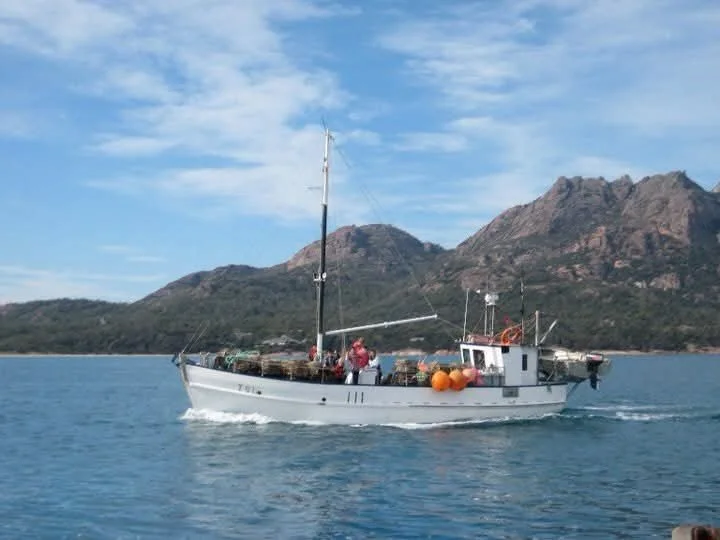
My father's cray boat on Tasmanian waters. This is what responsible fishing looks like to me.
Evidence-based guidance on seafood & sustainability - the two are more connected than we think.
I'm a fisherman's daughter.
My father was a professional cray fisherman. I grew up on the boat, up at 4am, out on the water, eating fish as fresh as it gets. I watched him work with a professionalism that made me proud. Proud of him, proud of the industry, proud of what it meant to harvest food from the sea with skill and care.
I have a shack now in the D'Entrecasteaux Channel in southern Tasmania, opposite the salmon farms. Over the years I've watched that waterway change in ways that are hard to come to terms with - debris building up on the shore, the water itself looking different, the ecosystem around it carrying a load it wasn't built for. What I grew up proud of and what I see happening to those waters are worlds apart, yet the same industry.
That tension is part of why I'm writing this, and so is the clinical picture. The evidence on farmed salmon - its nutritional profile, its environmental footprint, and what industrial aquaculture is doing to places like the channel I've loved my whole life - has shifted considerably. I'm not writing this from hostility toward fishing. I know what responsible fishing looks like. I want to talk about why farmed Atlantic salmon doesn't fit that picture, and what we might choose instead.
Something happened for me recently at a naturopathic conference that lit a bit of a fire under me.
Farmed Atlantic salmon was on the lunch menu. I checked with the catering staff - sure enough, it was Tasmanian. I'm not naïve about how venue catering works, and I know organisations rarely get a say in the specifics of what's served. But the irony of that moment was hard to ignore: a room full of people whose work is rooted in evidence-based nutrition, sitting down to the one protein that the latest research gives us the most reason to reconsider. What got me even more fired-up was the response when I mentioned it to a few mainland colleagues: every single one said, 'I had no idea.'
That's why this blog exists.
The farmed salmon question
It's healthy, right?
For years, salmon was the clinical shorthand for "how do I get more omega-3s?" - and for wild-caught salmon, that recommendation still holds up pretty darn well. Farmed Atlantic salmon, the kind filling supermarket fridges and restaurants across Australia and the planet, is a different story, and the evidence behind it has shifted more than most people realise.
The omega-3 content of farmed salmon has been declining. A 2025 study tracking Atlantic salmon feed and fillet composition from 2006 to 2021 found that long-chain omega-3 fatty acids (EPA and DHA) decreased in concentration over that period, as the industry shifted away from fish meal and fish oil toward plant-based alternatives.¹ Farmed salmon also carries roughly double the saturated fat per serving compared to wild-caught, a consequence of the higher overall fat load from modern feed formulations. The fish still contains omega-3s - but significantly less than it did twenty years ago, and what you're eating today is not the same nutritional profile you'd find in older studies.
There's also the issue of the omega-6 to omega-3 ratio. Modern aquaculture feeds, particularly those relying on plant-based ingredients like soy and canola, are higher in omega-6 fatty acids. One of the key reasons we recommend fish in the first place is to help balance an already omega-6-heavy diet. A farmed salmon raised on soy-dominant feed offers a considerably less favourable ratio than wild-caught fish.²
The persistent organic pollutant picture is complex, and I'd rather walk through it carefully and honestly than reach for easy alarm. A 2020 Norwegian analysis found that concentrations of dioxins and dioxin-like PCBs have decreased in both feed and farmed salmon over recent decades, largely because the industry shifted away from fish meal.³ That's a real improvement. The same feed reformulation has introduced new variables though - 2024 research shows that microplastics in feed affect the distribution of persistent halogenated pollutants in Atlantic salmon tissue, and that work is still unfolding.⁴
Emerging research also shows that microplastics in fish feed may reach the consumer's gut, where they've been shown to increase Proteobacteria - the class of inflammatory bacteria associated with dysbiosis - while displacing beneficial species.¹¹
The picture is not black and white. If you're eating farmed salmon for its health properties, it's worth knowing the nutritional case for it has weakened over time.
Part 2 coming soon - what's actually happening in Tasmanian waters, what the global research tells us, and what to eat instead.
References
Søfteland, L. et al. (2025). Nutrients and contaminants in farmed Atlantic salmon (Salmo salar) fillet and fish feed from 2006 to 2021. Food Chemistry: X. https://www.sciencedirect.com/science/article/pii/S2666154325003047
Turchini, G.M. et al. (2019). The omega-3 long-chain polyunsaturated fatty acid "squeeze": Past, present, and future. Annual Review of Food Science and Technology, 10, 301–322.
Lundebye, A.K. et al. (2020). An update on the content of fatty acids, dioxins, PCBs and heavy metals in farmed, escaped and wild Atlantic salmon (Salmo salar L.) in Norway. Nutrients, 13(1), 1. https://pmc.ncbi.nlm.nih.gov/articles/PMC7766777/
Monikh, F.A. et al. (2024). Microplastics in feed affect the toxicokinetics of persistent halogenated pollutants in Atlantic salmon. Environmental Pollution. https://www.sciencedirect.com/science/article/pii/S0269749124011357
Ragusa, A. et al. (2024). Frontiers in Cellular and Infection Microbiology. https://pmc.ncbi.nlm.nih.gov/articles/PMC11635378/